
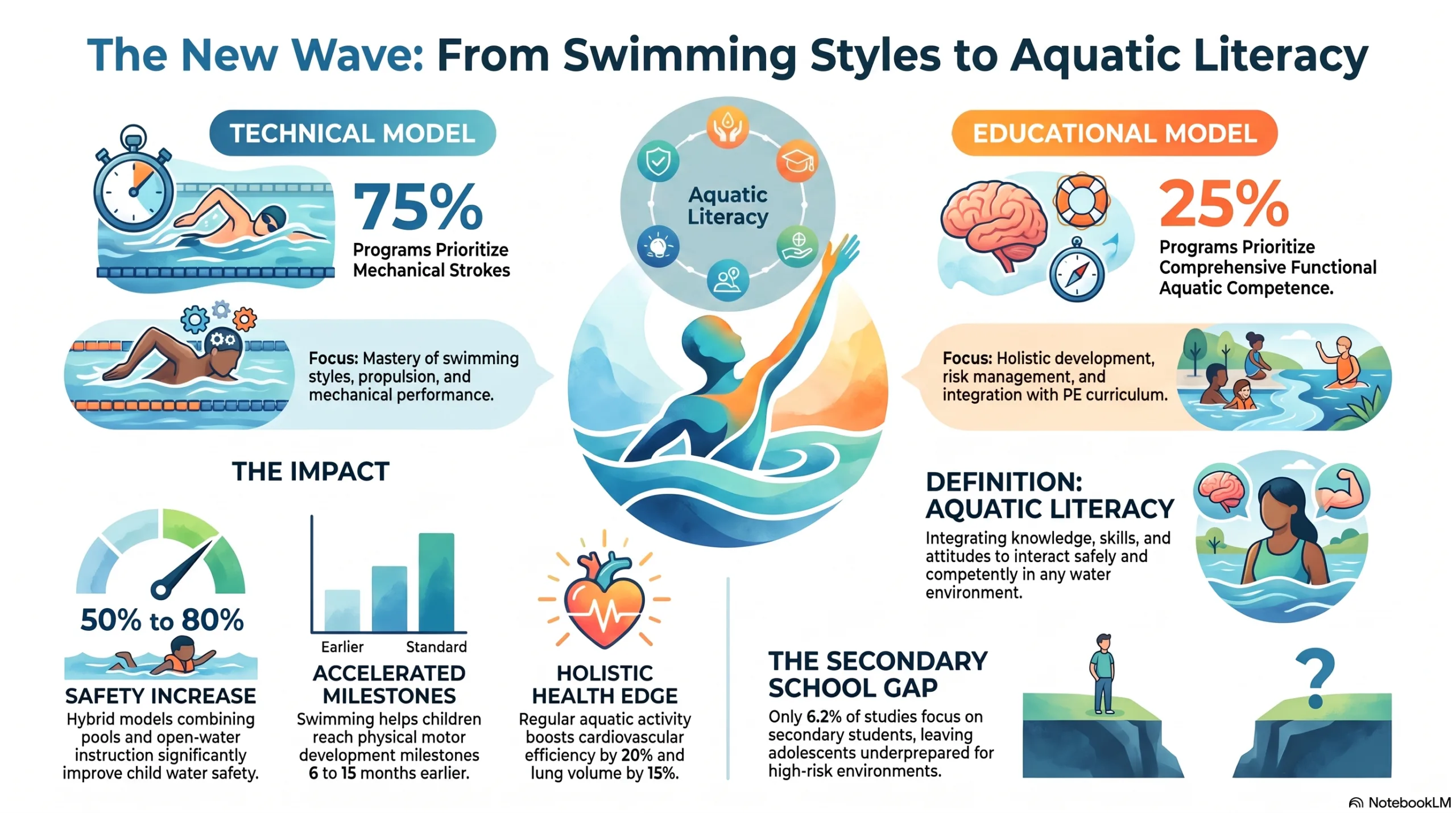
For most parents, watching a child complete their first length of the pool is a milestone marked by a profound sense of relief. We operate under the comforting assumption that “learning to swim”—mastering the basic mechanics of a stroke—is the same thing as being safe in the water. However, the data suggests this technical focus may be creating a dangerous false sense of security.

In a landmark 25-year systematic review recently published in PLOS One, lead researcher Alfonso Trinidad and his team at the Universidad Europea de Madrid argue that our current approach is fundamentally flawed. The data demands a radical recalibration of our priorities, shifting from simple swimming skills toward “Aquatic Literacy.” This concept, championed by the European ALFAC project, is defined as the integration of knowledge, skills, attitudes, and behaviors required to interact safely and competently across diverse aquatic environments.
The “Head Start” Effect: Reaching Milestones Months Earlier
Exposing children to the water early provides physical and neurological advantages that land-based activities simply cannot replicate. Because water is approximately 800 times denser than air, it creates a unique high-resistance, low-impact environment. This resistance doesn’t just build muscle; it facilitates superior neuropsychological development and essential cortisol regulation for emotional well-being.
The statistical evidence for early exposure is staggering. Research indicates a 20% improvement in cardiovascular efficiency and a 15% increase in lung volume compared to children involved in land-based sports. Furthermore, the long-term data provides a compelling case for the neurological impact on coordination.
“According to the 10-year follow-up of the Griffith study, early aquatic interventions enable children to reach physical development milestones between 6 and 15 months earlier than the average population.”
The Technical Trap: Why Style Doesn’t Equal Survival
Despite these benefits, the way we teach swimming is often “stuck” in a model from the 1990s. Trinidad et al. found that 75% of current school programs are dominated by a “technical-utilitarian” approach that has remained largely unchanged for two decades. This “Technical Trap” prioritizes mastering rigid, mechanical patterns of competitive strokes over the ability to problem-solve in the water.
This is where the European ALFAC (Aquatic Literacy for All Children) project enters the conversation. Experts argue we must move toward an “Educational-Curricular” approach. A child who can swim a perfect freestyle in a calm, heated pool is not necessarily equipped to handle the unpredictable variables—waves, currents, or cold temperatures—of a natural body of water.

The Secondary School “Black Hole”
One of the most alarming findings of the systematic review is the “black hole” of aquatic education for teenagers. While programs are plentiful for toddlers and primary students, secondary education accounts for a meager 6.2% of the total research output. This gap isn’t just an academic oversight; it is a public health risk.
Neglecting aquatic education in later years directly contravenes World Health Organization (WHO) safety guidelines. Adolescents are a high-risk group who require advanced aquatic literacy, including risk assessment and complex decision-making in variable environments. As children grow into independent young adults, the curriculum often fails to provide the advanced competencies needed to navigate the waters they are most likely to encounter.
Pedagogy Over Performance: The Teacher vs. The Medalist
There is a common misconception that a former competitive swimmer or a professional coach is the best person to lead a class. However, the research highlights a significant “Pedagogical Gap” between external technical staff and university-trained Physical Education (PE) teachers. While coaches possess “federative training” focused on sport-technical performance, they often lack the formal pedagogical training required to manage heterogeneous groups.
Success in the water depends more on a teacher’s “professional judgment”—the ability to adapt a motor challenge to an individual student—than on technical mastery. PE teachers consistently achieve better results because they prioritize comprehensive aquatic competence over the execution of a specific stroke.
“The data reveals that students in technical programs often show deficiencies in transferring skills to real-life risk situations, such as floating while fully clothed, compared to those trained by teachers who prioritize comprehensive aquatic literacy.”
The Open Water Advantage: A 50-80% Safety Boost
To bridge the gap between the pool and the real world, the review advocates for a “Hybrid Model.” This approach, particularly effective for children aged 7–11, combines traditional pool sessions with “Environmental Adaptation” in open-water settings. The results of this model, cited from the 2023 study by Button et al., show a massive leap in survival-related skills.
The statistics supporting a hybrid approach include:
- A 50% to 80% improvement in overall water safety.
- A 37% improvement in buoyancy competencies.
- A 22% improvement in general swimming ability.
Swimming skills alone are insufficient to prevent drowning if a child has never been taught to adapt those skills to the unpredictability of a natural environment. True safety requires the ability to remain calm and functional when the conditions are no longer “perfect.”
Conclusion: From Strokes to Literacy
The evidence provided by Trinidad et al. makes one thing clear: we must stop measuring success by the speed of a lap or the beauty of a stroke. We must shift our focus toward achieving “comprehensive aquatic autonomy,” a model that integrates physical, cognitive, and affective development.
Schools must serve as the primary vehicle for this life-saving education, ensuring that aquatic literacy is treated as a core curricular requirement rather than an optional extra. As parents and educators, we must ask ourselves a difficult question: Are we teaching our children how to win a race, or are we teaching them how to survive the water?
Credit Trinidad et al., CC BY 4.0, read the full study here on PLOS One
Leave a Reply